
Cartilage regeneration
My research focus: targeted treatment of cartilage damage – with the whole joint in mind.
Book appointment
Cartilage damage in the knee
Joint cartilage covers the joint surfaces of the thigh bone, shin bone and kneecap. It allows almost frictionless gliding and distributes load to the underlying bone. Because cartilage has no blood vessels of its own, it can hardly regenerate itself after an injury.
Cartilage damage is caused by accidents, for example a kneecap dislocation or a ligament injury, by osteochondritis dissecans or by long-term incorrect loading and overloading. If left untreated, it can grow larger and lead to osteoarthritis in the long term. Timely, well-planned treatment can preserve your own joint.
My research focus
Cartilage regeneration is the focus of my clinical and scientific work. Among other things, I study the results of cartilage regenerative procedures, the factors that influence their success and the role of inflammation in the joint. This knowledge feeds directly into the treatment of my patients.
I am involved in the following committees in the cartilage research community:
The whole joint in view
Cartilage damage is rarely an isolated problem. The key to successful cartilage treatment is therefore to look not only at the defect but at the whole joint, and to treat every factor that puts strain on the cartilage:
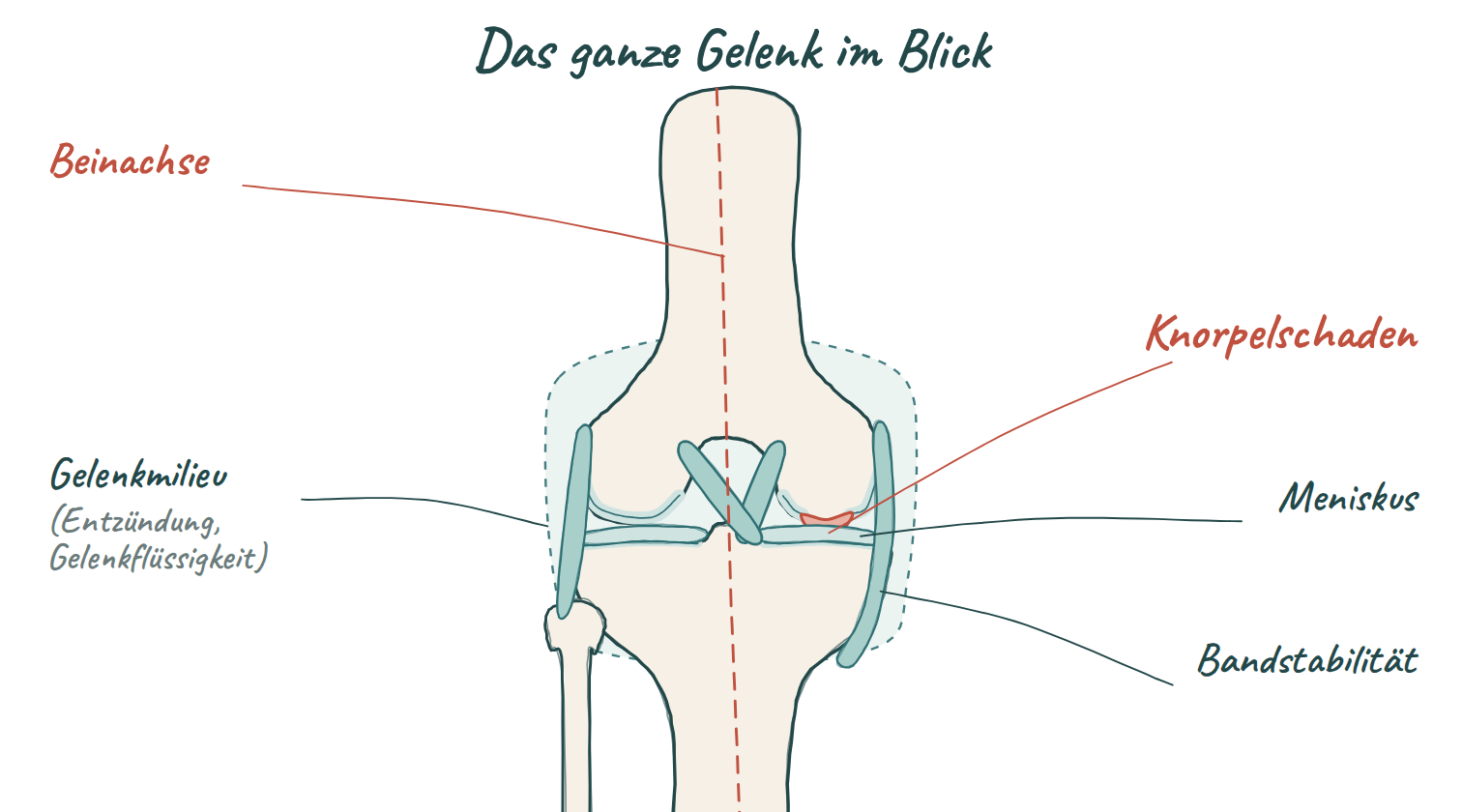
- Leg axis – bow legs or knock knees overload one part of the joint and put any cartilage treatment at risk; the axis is corrected if needed.
- Stability – an unstable knee, for example after an ACL tear or a kneecap dislocation, damages the cartilage again and again.
- Meniscus – a functioning meniscus protects the cartilage; missing meniscus tissue is replaced where possible.
- Joint homeostasis – an inflamed joint environment impairs healing; inflammation in the joint is a focus of my research.
Diagnosis
In addition to a detailed medical history and clinical examination, a high-quality MRI with special cartilage sequences is essential. It shows the size, depth and location of the damage and any involvement of the bone. A full-leg X-ray taken standing completes the assessment so that the leg axis can be measured precisely.
Have your cartilage damage assessed
Please bring your MRI images if available. We will discuss whether and which cartilage regenerative procedure is suitable for you at my practice in 1090 Vienna. Appointments can be booked online.
Procedures at a glance
Which procedure is suitable depends on the size, location and depth of the defect, any involvement of the bone, and your age and activity level. The main procedures:
Associated procedures
Alongside the actual cartilage treatment – usually in the same operation – the factors that put strain on the cartilage are treated: axis correction for bow legs or knock knees, ligament reconstruction for instability, kneecap stabilisation and preservation or replacement of the meniscus. These associated procedures are at least as decisive for long-term success as the cartilage procedure itself.
Rehabilitation & return to sport
The newly formed cartilage tissue needs time to mature and become resilient. Rehabilitation is therefore consistent and, in its later course, similar to that after an ACL reconstruction. As a guide:
- First 6 weeksProtecting the graftno or partial weight-bearing with crutches, limited range of motion, continuous passive motion machine (CPM)
- From week 6Increasing loadgradual transition to full weight-bearing, free range of motion, physiotherapy
- Following monthsStrength & coordinationtargeted muscle building and stability training, similar to after ACL surgery
- After about 12 monthsReturn to contact sportafter passing functional tests
Detailed rehabilitation plan after cartilage treatment → (in German, also as PDF)
Frequently asked questions
Can cartilage grow back?
Hardly on its own – joint cartilage has only a very limited capacity to heal. Cartilage regenerative procedures stimulate the formation of replacement tissue or bring new cartilage tissue into the defect.
Which procedure is best?
That depends on the size, location and depth of the defect and any involvement of the bone. At least as important as the procedure itself is treating associated problems such as malalignment, instability or loss of meniscus.
Is cartilage treatment possible with osteoarthritis?
Cartilage regenerative procedures are intended for localised cartilage damage. They are usually not suitable for advanced, widespread osteoarthritis – here, other joint-preserving measures such as axis correction or injections are considered.
What does treatment cost?
As a private doctor (Wahlarzt), I bill privately; your health insurance reimburses part of the costs. Operations are performed at AKH Wien or Privatklinik Döbling. Full details on the Fees & insurance page.
My research on cartilage regeneration
A selection of my scientific publications on cartilage damage, cartilage therapy and joint inflammation:
- Specialized pro-resolving mediators alleviate inflammation and cartilage breakdown in vitro and may play a pivotal role in platelet-rich plasma
- Adjuvant injection therapies following knee cartilage repair demonstrate heterogeneous evidence: A systematic review
- YouTube Videos on Osteochondral Allograft Transplantation Lack Accuracy and Quality
- Osteochondral Allograft Transplantation for Treatment of a Focal Tibial Plateau Cartilage Lesion
- Effect of specialized pro-resolving mediators on knee joint inflammation
- Hydrogel‐based and spheroid‐based autologous chondrocyte implantation of the knee show similar 2‐year functional outcomes: An analysis based on the German Cartilage Registry (KnorpelRegister DGOU)
- The role of Periostin as a biomarker of anterior cruciate ligament injury and potential therapeutic target to alleviate post-traumatic cartilage degeneration
- Increased risk of reoperation and failure to attain clinically relevant improvement following autologous chondrocyte implantation of the knee in female patients and individuals with previous surgeries: a time‐to‐event analysis based on the German cartilage registry (KnorpelRegister DGOU)
- Bipolar Lesions of the Knee Are Associated With Inferior Clinical Outcome Following Articular Cartilage Regeneration. A Propensity Score‐Matched Analysis Including 238 Patients of the German Cartilage Registry (KnorpelRegister DGOU)
Book an appointment
Do you have cartilage damage or would you like a second opinion on your MRI report or a planned cartilage treatment? Book your appointment at my practice in 1090 Vienna online. After a fresh injury, please call me and we will quickly find an urgent appointment.
Contact me!
I am happy to help with questions, appointments or a personal consultation.