
Meniscus tear
Preserve the meniscus rather than remove it – diagnosis, repair, transplantation and return to sport based on current evidence.
Book appointment
What is a meniscus tear?
The two menisci – medial and lateral – are crescent-shaped structures made of fibrocartilage between the thigh bone and the shin bone. They distribute load, act as shock absorbers, stabilise the joint and protect the joint cartilage. If meniscus tissue is lost, the load on the cartilage increases significantly – and with it the long-term risk of osteoarthritis.
In young, active people, meniscus tears usually occur when the bent knee is twisted, often together with an ACL tear. With increasing age, the meniscus can also tear through wear and tear – often without any accident.
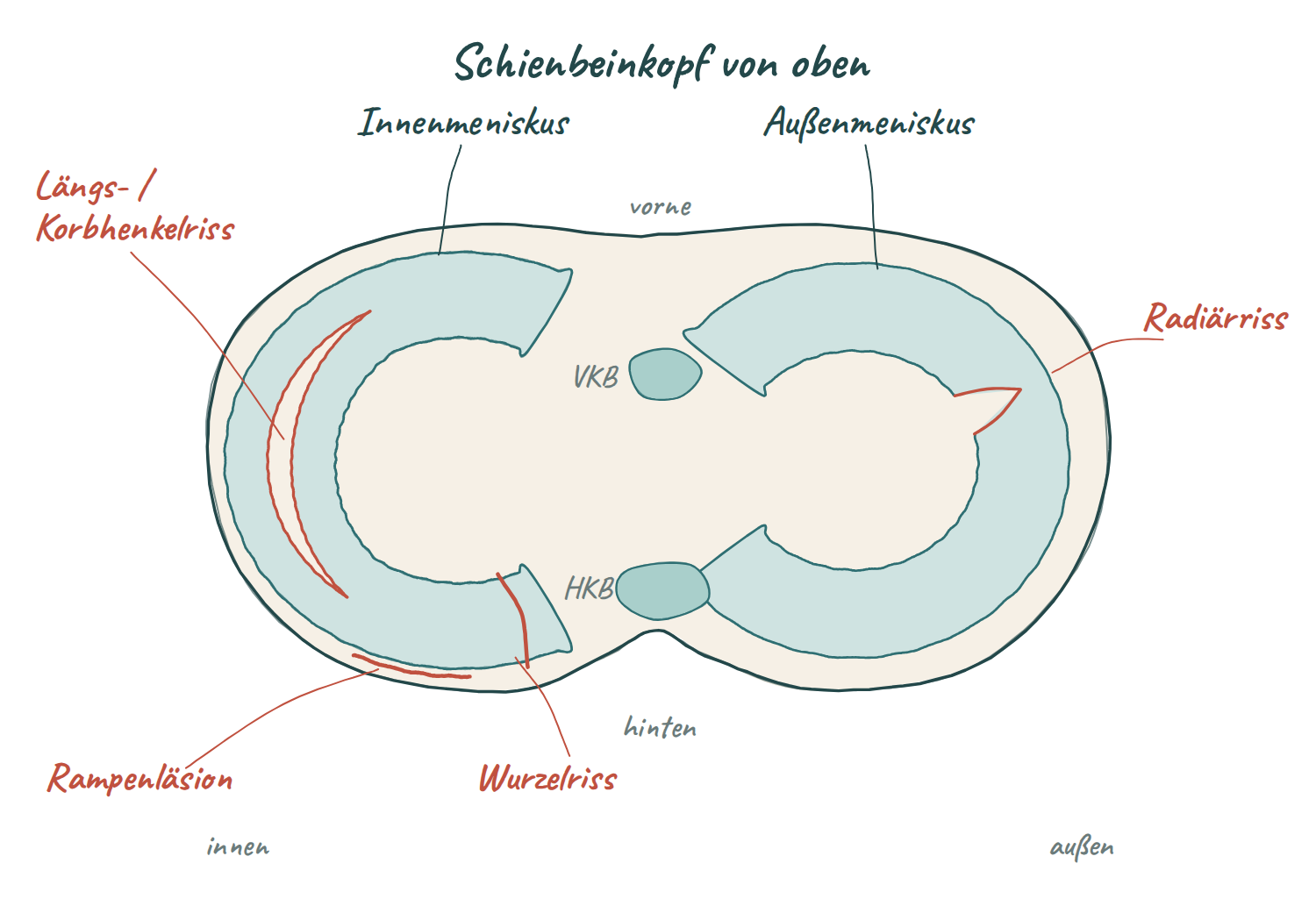
Types of tear
The shape, location and size of the tear and the quality of the tissue determine the treatment:
Symptoms & diagnosis
Typical symptoms are pain along the joint line, especially when twisting, squatting or climbing stairs, plus swelling and sometimes catching or locking of the knee. A thorough clinical examination already provides important clues.
MRI shows the type of tear, its location and associated injuries. Interpretation is important: wear-related meniscus changes are often seen on MRI in people without any symptoms – not every finding is the cause of the pain. Conversely, some tears, such as ramp lesions with ACL injuries, are easily missed – as our own research shows.

Have your meniscus checked
Please bring your MRI images if available. Appointments at my practice in 1090 Vienna can be booked online. After a fresh injury, please call me and we will quickly find an urgent appointment.
Treatment without surgery
For wear-related meniscus tears without mechanical symptoms, current evidence supports conservative treatment as the first step: targeted physiotherapy with strengthening and coordination over several weeks to months, plus pain relief and injections if needed. Arthroscopy usually brings no additional benefit in this situation. Small, stable tears in the well-vascularised outer zone can also heal without surgery.
Preserving the meniscus: repair instead of removal
My treatment follows current scientific evidence: preserve rather than remove. Whenever the tear and tissue quality allow, the meniscus is repaired arthroscopically. Modern suture techniques now make it possible to repair many types of tear that used to be removed:
- Meniscus repair – for longitudinal, bucket-handle and suitable radial tears
- Root repair – the torn meniscus root is reattached to the bone
- Repair of ramp lesions – usually together with an ACL reconstruction
- Partial meniscectomy – only if a tear cannot be repaired and causes mechanical symptoms; as much meniscus as possible is preserved
If there is also an ACL tear, both injuries are treated in the same operation – the ACL reconstruction protects the meniscus repair and improves its healing. More on my ACL tear page.
Meniscus transplantation
If a meniscus has already been removed completely or largely, pain in the affected part of the joint and early cartilage wear can result. For selected, mostly younger patients, meniscus transplantation offers a way to restore the function of the meniscus.
A donor meniscus from a certified tissue bank, measured to fit, is inserted arthroscopically and firmly anchored. Requirements are a stable knee, a straight leg axis and no advanced cartilage damage. Instability or malalignment is corrected in the same operation if necessary. The aim is to relieve symptoms and protect the cartilage in the long term.
Rehabilitation & return to sport
Rehabilitation depends very much on the procedure. As a guide:
- After partial removalRapid weight-bearingusually as symptoms allow; return to sport often after a few weeks
- After repair: first 6 weeksProtecting the repairpartial weight-bearing of 20 kg with crutches, bending in a brace gradually up to 90°
- Following monthsStrength & coordinationtransition to full weight-bearing, targeted muscle building and stability training
- Return to sportAfter repair usually 5–6 months, with root or complex tears 6–9 monthsafter meniscus transplantation usually considerably later, decided individually
Detailed rehabilitation plans (in German, also as PDF): meniscus repair, partial meniscectomy and meniscus transplantation
Frequently asked questions
Does a meniscus tear always need surgery?
No. Wear-related tears without locking are first treated conservatively. Surgery is mainly advisable for injury-related tears that can be repaired, if the knee locks or if mechanical symptoms persist.
Repair or partial removal – which is better?
If possible, repair is the better choice because it preserves the protective function of the meniscus. Partial removal allows a faster return to everyday life but can increase the risk of osteoarthritis in the long term. Which option is suitable in your case depends on the type of tear, its location and tissue quality.
Does a repaired meniscus heal reliably?
In the well-vascularised outer zone and in younger patients, the chances of healing are good. A simultaneous ACL reconstruction improves healing further. It is important to follow the rehabilitation guidelines in the first weeks.
Who is a candidate for meniscus transplantation?
Mainly younger, active people who have pain in the affected part of the joint after a previous meniscus removal – with a stable knee, straight leg axis and well-preserved cartilage. I assess whether these requirements are met in a detailed examination with up-to-date imaging.
What does treatment cost?
As a private doctor (Wahlarzt), I bill privately; your health insurance reimburses part of the costs. Operations are performed at AKH Wien or Privatklinik Döbling. Full details on the Fees & insurance page.
Book an appointment
Do you have meniscus problems, a locked knee or would you like a second opinion on your MRI report or a planned operation? Book your appointment at my practice in 1090 Vienna online. After a fresh injury, please call me and we will quickly find an urgent appointment.
Contact me!
I am happy to help with questions, appointments or a personal consultation.