
Knee osteoarthritis
Relieve symptoms, stay active and keep your own knee joint for as long as possible.
Book appointment
What is knee osteoarthritis (gonarthrosis)?
In knee osteoarthritis (gonarthrosis, wear and tear of the knee), the joint cartilage gradually becomes thinner. The bone underneath reacts by becoming denser and forming bony outgrowths, and the joint lining can become inflamed.
Common causes are previous injuries to the meniscus, cruciate ligament or cartilage, a misaligned leg axis (bow legs or knock knees), excess weight and genetic predisposition. Osteoarthritis does not progress the same way in everyone: many people have manageable symptoms for a long time, and the X-ray findings often correspond only loosely to the severity of the pain.
Where the osteoarthritis is located
The knee joint has three compartments. Which one is affected determines the treatment.
If only one compartment is affected, joint-preserving procedures such as axis correction are more likely to be an option.
Symptoms and examination
Typical symptoms are start-up pain in the morning or after sitting, pain after prolonged activity, recurrent swelling and increasing stiffness.
At my practice in Vienna, we start with a detailed conversation and a thorough examination. X-rays taken standing show the joint space; a full-leg X-ray shows the leg axis.
An MRI is not always necessary for osteoarthritis. In younger patients or with unclear symptoms, however, it provides important additional information on cartilage, menisci and ligaments.
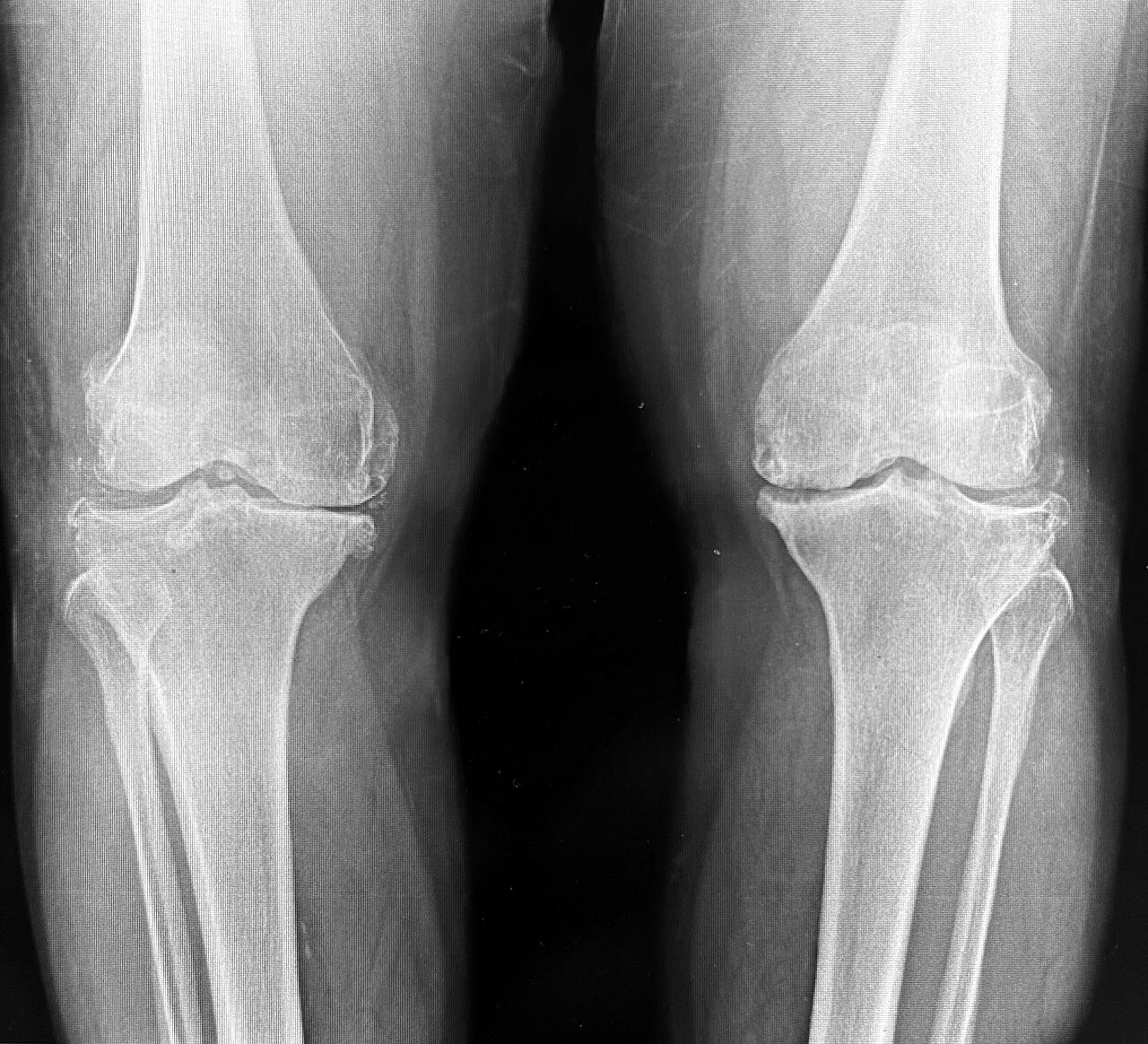
Have your knee osteoarthritis assessed
Please bring X-ray and MRI images if available. Appointments at my practice in 1090 Vienna can be booked online. If you need an appointment sooner, please call me.
Treatment without surgery
The basis of every osteoarthritis treatment, at every stage, is targeted exercise, plus weight loss if you are overweight.
- Strengthening the thigh and hip muscles, guided by physiotherapy and then continued independently
- Joint-friendly endurance sport such as cycling, swimming or Nordic walking
- If needed, painkillers for a short time, insoles or an offloading brace for one-sided osteoarthritis
Injections
Injections into the joint can relieve symptoms and make exercise easier. Cortisone works quickly but usually only for a few weeks. Hyaluronic acid and PRP (platelet-rich plasma) can relieve symptoms for longer; study results on this vary. We will discuss together which injection suits your situation. More on the Injection therapy page.
Axis correction (osteotomy)
In one-sided osteoarthritis with bow legs or knock knees, correcting the leg axis can shift the load onto the healthy compartment. This can often delay or avoid a knee replacement for years.
With a straight leg axis, the weight-bearing line of the leg runs roughly through the middle of the knee. With bow legs (varus), it shifts inwards; with knock knees (valgus), outwards. The affected compartment then carries more load with every step.
Who it is suitable for
The overall picture matters, not age alone.
- Wear mainly in one compartment, with the other compartment largely healthy
- Active people, usually up to their mid-60s, who want to stay active in sport or at work
- Alongside cartilage or meniscus treatment, to offload the repaired tissue
- In some ligament instabilities or revision ACL surgery, when the slope of the shin bone also needs correcting
It is less suitable for advanced osteoarthritis in several compartments, markedly restricted movement or inflammatory joint diseases.
Planning and surgery
The basis is a full-leg X-ray taken standing so that the correction angle can be calculated precisely. An MRI assesses cartilage, menisci and ligaments. The correction is planned digitally before the operation.
At the start of the operation, I look inside the knee joint with an arthroscopy. This allows cartilage and menisci to be assessed and, if needed, treated in the same operation. The bone near the knee is then cut in a controlled way, the axis is corrected by the planned angle and fixed with an angle-stable plate.
- Bow legs: correction at the top of the shin bone (high tibial osteotomy, HTO)
- Knock knees: correction usually at the lower end of the thigh bone (distal femoral osteotomy, DFO)
- Complex malalignment: correction on both bones (double-level osteotomy)
Rehabilitation
- First weeksWeight-bearingHTO: increasing load as pain allows, full weight-bearing usually after 2–4 weeks. DFO: partial weight-bearing of 20 kg for 6 weeks
- From the startMovementfree, no brace needed
- After 2–6 weeksEveryday life and workoffice work usually after 2–6 weeks, physical work after 3–5 months
- From 3–4 monthsSportjoint-friendly sports, return to sport usually within 6 months
Detailed rehabilitation plan: axis correction (in German, also as PDF)
An osteotomy does not cure osteoarthritis; it shifts the load. In a meta-analysis, most patients returned to sport and work after osteotomy around the knee (Hoorntje et al., 2017).
Knee replacement (artificial knee joint)
If osteoarthritis is far advanced and symptoms severely limit everyday life despite consistent treatment, a knee replacement is a well-established option. Only the worn joint surfaces are replaced: metal caps on the thigh bone and shin bone, with a plastic gliding surface in between. Ligaments and muscles are preserved.
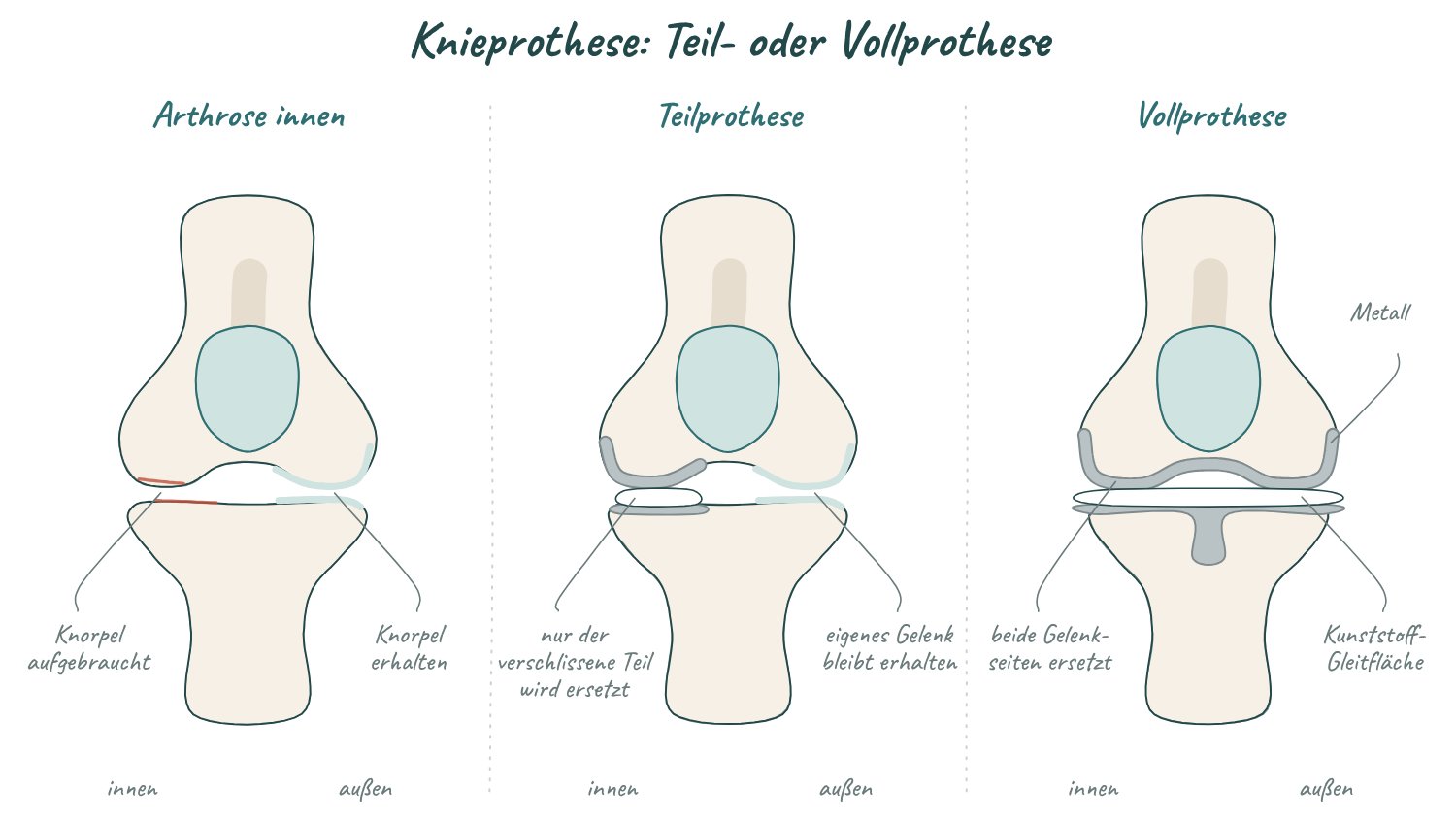
Partial or total knee replacement
- Partial knee replacement (unicompartmental): replaces only the worn compartment, usually the inner one. The other compartments and the cruciate ligaments must be largely intact. Recovery is often somewhat quicker.
- Total knee replacement (resurfacing): replaces the joint surfaces of the thigh bone and shin bone, and if needed the back of the kneecap. It is considered for osteoarthritis in several compartments or marked malalignment.
Which option is right depends on the X-ray, the condition of the ligaments and what you expect of your knee.
The right time
What matters is not the X-ray or age alone, but how much pain and limitations affect your everyday life and whether treatment without surgery has been exhausted. I will advise you in detail on whether and when this step makes sense and what expectations are realistic.
After the operation
- Getting up usually on the same day, at first with crutches
- Physiotherapy for movement and strength, often followed by a rehabilitation programme
- Joint-friendly sports such as cycling, swimming or hiking are usually possible again
Knee replacements usually last many years: in a large analysis of registry data, about 82% of total and 70% of partial knee replacements were still functioning after 25 years (Evans et al., 2019).
Frequently asked questions
Can I do sport with osteoarthritis?
Yes, exercise is a central part of treatment. Joint-friendly sports are usually possible, often running in moderation too.
Can cartilage grow back?
Not in widespread osteoarthritis. For localised cartilage damage in younger people, there are procedures that can form new cartilage tissue.
Does arthroscopy help with osteoarthritis?
No. According to current evidence, arthroscopy to wash out or smooth the cartilage is not recommended for osteoarthritis.
Am I too old for axis correction?
What matters is activity, bone quality and the condition of the other compartments, not age alone.
Can a knee replacement be fitted later after axis correction?
Yes, a previous axis correction does not rule out a later knee replacement.
Does the plate have to be removed?
Not necessarily. If it causes problems, it can be removed in a minor procedure after the bone has healed, at the earliest after about one year.
When should I have my knee assessed?
If pain persists for weeks despite exercise, the knee swells repeatedly or you have to limit everyday life or sport.
What does treatment cost?
Operations are performed at AKH Wien or Privatklinik Döbling. Information on fees and reimbursement is on the Fees & insurance page.
Book an appointment
Do you have knee pain from osteoarthritis, bow legs or knock knees causing symptoms, or would you like a second opinion on a planned knee replacement? Bring existing X-ray and MRI images, ideally a full-leg X-ray too. Book your appointment at my practice in 1090 Vienna online. If you need an appointment sooner, please call me.
Contact me!
I am happy to help with questions, appointments or a personal consultation.