
Knee injections
Hyaluronic acid and PRP for the knee – clearly explained: what an injection can and cannot do.
Book appointment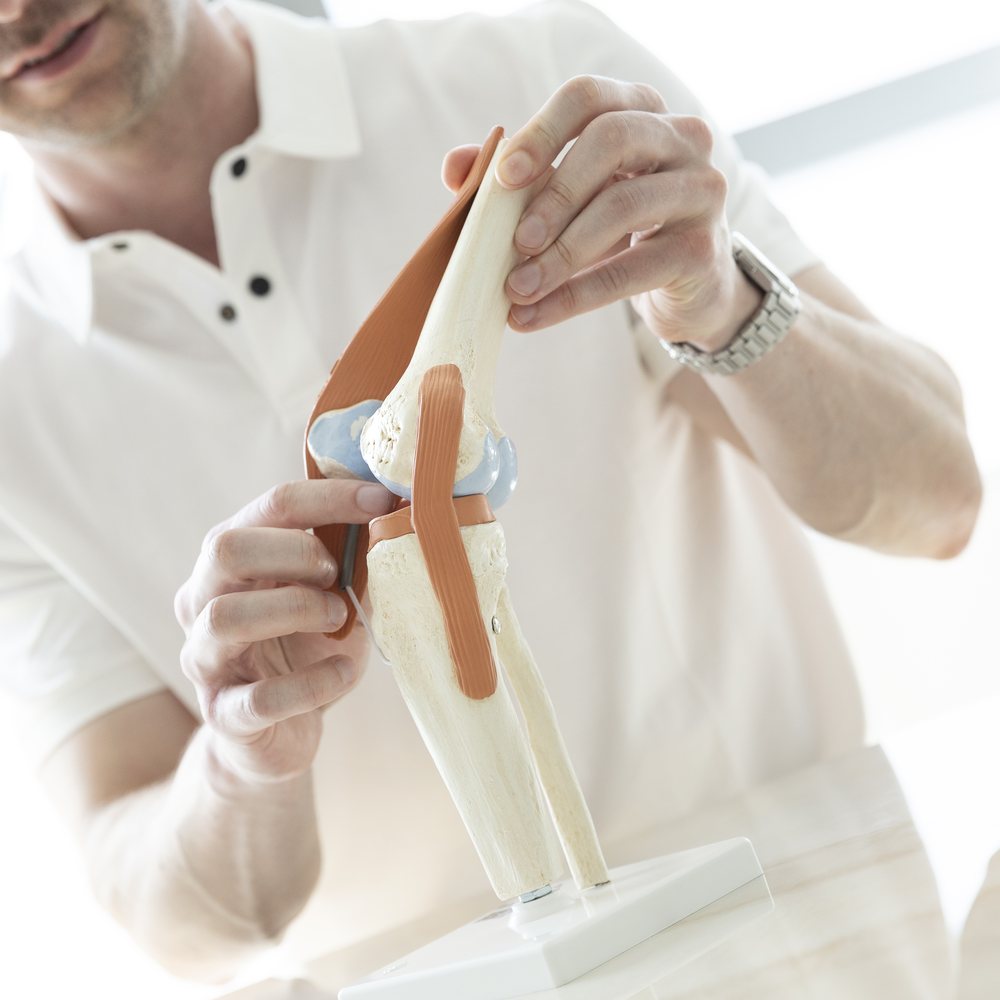
What is a knee injection?
In a knee injection, an active substance is injected directly into the knee joint. The aim is to relieve pain and inflammation and improve mobility – especially in early or moderate knee osteoarthritis and cartilage damage. An injection cannot replace surgery if there is a structural cause such as instability, a locked meniscus or marked malalignment. However, it can be part of a well-coordinated conservative treatment plan – together with targeted exercise, physiotherapy and, where appropriate, weight reduction.
A confusing market
Hardly any area of orthopaedics is as difficult for patients to see through as injection therapy. Under terms such as “cartilage regeneration”, “joint lubricant” or “regenerative medicine”, numerous products and procedures are offered – at very different prices and with very different scientific foundations.
What I offer
I have deliberately chosen two procedures that are well researched and complement each other in how they work. Which one is suitable for you depends on the extent of the osteoarthritis or cartilage damage, your symptoms and your goals.
Hyaluronic acid with cortisone
Hyaluronic acid is a natural component of joint fluid and gives it its gliding and cushioning properties. I use a product that combines cross-linked hyaluronic acid with a long-acting cortisone (triamcinolone hexacetonide) in a single injection. The cortisone relieves inflammation and pain quickly; the hyaluronic acid contributes to a longer-lasting effect. In studies, the effect lasted up to six months.
- One injection instead of a series
- Rapid onset thanks to the cortisone
- Suitable above all for painful flare-ups of knee osteoarthritis
PRP – platelet-rich plasma
For PRP, a small amount of your own blood is taken and processed in a centrifuge. The concentrated plasma contains platelets with growth factors and other signalling substances that influence inflammation in the joint. As it is made from your own blood, the risk of allergic reactions is very low.
Overall, the evidence on PRP for knee osteoarthritis is encouraging but not consistent: many studies show improvement in pain and function over several months, especially in mild to moderate osteoarthritis; others, including a large placebo-controlled study, found no benefit. One reason is the wide range of preparation methods. A standardised preparation method is therefore essential. I will discuss openly with you which system I use and what you can realistically expect.
- 3–5 injections one week apart are recommended
- Made from your own blood – prepared immediately before the injection
Background: research on PRP and orthobiologics
During my research fellowship at Harvard Medical School, I studied biological therapies for the knee together with colleagues. This led, among other things, to the chapter “Orthobiologics – growth factors and mediators” in the textbook OrthoBiologics (Elsevier, 2024).
One topic of this work was specialised pro-resolving mediators (SPMs) – the body’s own signalling substances that actively end inflammation rather than just suppressing it. The results suggest that SPMs reduce inflammation and cartilage breakdown in the laboratory and may play a role in how PRP works (Scientific Reports, 2025; The Knee, 2025). Another review I contributed to shows how inconsistent the evidence for additional injections after cartilage repair currently is (Journal of Experimental Orthopaedics, 2025).
Discuss an injection
Whether a hyaluronic acid or PRP injection makes sense for your knee is something I clarify beforehand with an examination and, if available, your X-ray or MRI images. Appointments at my practice in 1090 Vienna can be booked online.
What about stem cells?
“Stem cell therapies” are increasingly advertised for the knee. They are usually concentrates from bone marrow or processed fat tissue that contain only a very small proportion of actual stem cells. Well-controlled studies with sufficiently long follow-up are still lacking; whether these procedures work better than simpler and much cheaper alternatives has not been proven.
How it works
- Step 1Consultation & examinationClinical examination and assessment of your X-ray or MRI images. Together we decide whether an injection makes sense – and which one.
- Step 2InjectionPerformed under strictly sterile conditions at the practice. For PRP, blood is taken and prepared immediately beforehand.
- AfterwardsRestRest the knee on the day of the injection; everyday activity is possible again afterwards. We discuss sporting activity individually.
- Follow-upCheck-upFor PRP, the further injections follow at one-week intervals. At a check-up, we assess the effect and plan together whether and when further treatment makes sense.
Frequently asked questions
Does an injection rebuild cartilage?
No. Neither hyaluronic acid nor PRP has been shown to rebuild lost cartilage. The aim is to reduce pain and inflammation and improve function. For larger, localised cartilage damage, there are surgical procedures – more under Cartilage regeneration.
How quickly does the treatment work?
The combination with cortisone usually works within a few days. PRP takes effect more slowly, usually over several weeks.
How often can the knee be injected?
I give PRP as a cycle of 3–5 injections one week apart. Whether and when another cycle makes sense depends on progress. I use the combination of hyaluronic acid and cortisone once or twice a year.
Isn’t cortisone harmful to the joint?
Frequently repeated injections of cortisone alone are viewed critically. In combination with hyaluronic acid, cortisone is used in a targeted way and at longer intervals. We discuss individually how often an injection makes sense.
Which treatment is right for me?
That depends on the extent of the changes in the joint, your symptoms and your goals. An injection is not always appropriate – I will tell you that openly too.
What does an injection cost?
An injection of hyaluronic acid with cortisone costs €330, a PRP injection €150. The consultation fee is charged only once per treatment cycle. The products are usually not covered by public health insurance. More under Fees & insurance.
Publications on orthobiologics
A selection of scientific work on biological therapies, PRP and joint inflammation that I have contributed to:
- Specialized pro-resolving mediators alleviate inflammation and cartilage breakdown in vitro and may play a pivotal role in platelet-rich plasma
- Adjuvant injection therapies following knee cartilage repair demonstrate heterogeneous evidence: A systematic review
- Effect of specialized pro-resolving mediators on knee joint inflammation
- Orthobiologics—growth factors and mediators
Book an appointment
Do you have knee pain from osteoarthritis or cartilage damage and want to know whether an injection makes sense for you? Or would you like a second opinion on a procedure you have been offered? Book your appointment at my practice in 1090 Vienna online.
Contact me!
I am happy to help with questions, appointments or a personal consultation.